



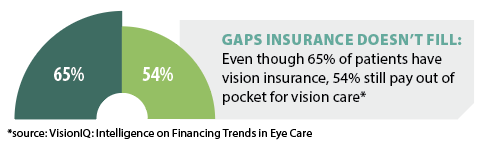
Are cost concerns keeping your patients away—or limiting their buying decisions? According to VisionIQ: Intelligence on Financing Trends in Eye Care (conducted by Ipsos on behalf of Synchrony), 64% of consumers say cost strongly or somewhat impacts how often they visit an optometrist (rising to 78% for Gen Z). But ensuring that your patients know vision care financing options exist can help change their purchasing decisions. According to the study, 43% of consumers say they’d be more likely to get vision care if they could pay in installments.
“Financing meets patients where they are,” says Jean Moody, vice president at Synchrony, which operates CareCredit. “I think optometrists sometimes assume patients wouldn’t want to finance a $200 pair of glasses, but breaking that into smaller installments is appealing to a lot of people. And when offered financing, suddenly a patient might be willing to consider a second pair.”
The study demonstrates a gap between what consumers are willing to do and what they actually do regarding purchases. According to the study, 43% of consumers say they are comfortable using a healthcare credit card to finance vision care expenses, yet only 7% of consumers actually have. The reason is that patients simply may not know vision care financing is an option.
Moody says conversational education is key—and it needs to come from the practice early on. If it’s left to the patient to ask if financing is an option, a conversion opportunity might already be lost.
“Many practices already have financing and simply don’t leverage it enough,” she says. “Every patient needs to be told about their payment options. While it is understandable some practices are uncomfortable talking about anything financial, the research shows patients want these options. In today’s world, patients want to finance even small amounts of money.”
When making a purchase, Moody says that patients also tend to buy within the range of their monthly budget—so financing makes larger vision care purchases feasible. The study found nearly 8 out of 10 consumers say they’d seriously consider financing once out-of-pocket costs reach a certain point ($761 on average). Gen Z and Millennials are more likely to seriously consider financing even lower amounts.
They’re Already in the Door:
- 94% of consumers who have ever seen an eye doctor have seen an optometrist
- 50% say their most recent visit was to an optometrist (compared with 22% for ophthalmologists and 14% for opticians)
- Patients are coming frequently: 51% visited an optometrist in the past year; among Gen Z, 20% visited in the past three months (vs. 13% overall)
(source: VisionIQ: Intelligence on Financing Trends in Eye Care)
These younger generations are also the ones more likely to own designer eyewear (36% of Millennials and 33% of Gen Z, compared to 28% overall), making them more likely to choose premium products. However,
Gen Z is also the most likely group to let cost concerns stop them if payment options aren’t presented.
“Financing has become the American way, and it should be no different in optometry,” Moody sums up. “It pains me when I see practices struggling with revenue because these financing tools are available and can play such a powerful role.”
To access the Synchrony VisionIQ study, visit www.carecredit.com/providers/insights/vision-care-industry-study.
Content sponsored by

(This information is shared solely for your convenience. You are urged to consult with your individual advisors with respect to any information presented.)